Last updated 11 August 2026
Performance testing
This catalogue sells on numbers, so this page explains where every number comes from, what it does not cover, and which claims we refuse to make at all. If a figure on a product page contradicts this page, this page is correct — tell us and we will fix the product page.
The wrinkle scale
Every woven garment we sell carries a grade from 1 to 5. The grade is the result of one fixed test, run on a finished production garment in the size we sell most of:
- The garment is laundered once and dried per its care label, then conditioned for 24 hours at 22°C and 55% relative humidity.
- It is folded in thirds, the way it would be packed.
- A 5 kg flat weight is placed on it for 12 hours.
- The weight is removed and the garment hangs on a plain hanger in still air for 30 minutes.
- Three people independently read it against a five-step visual reference. The published grade is the lowest of the three readings, not the average.
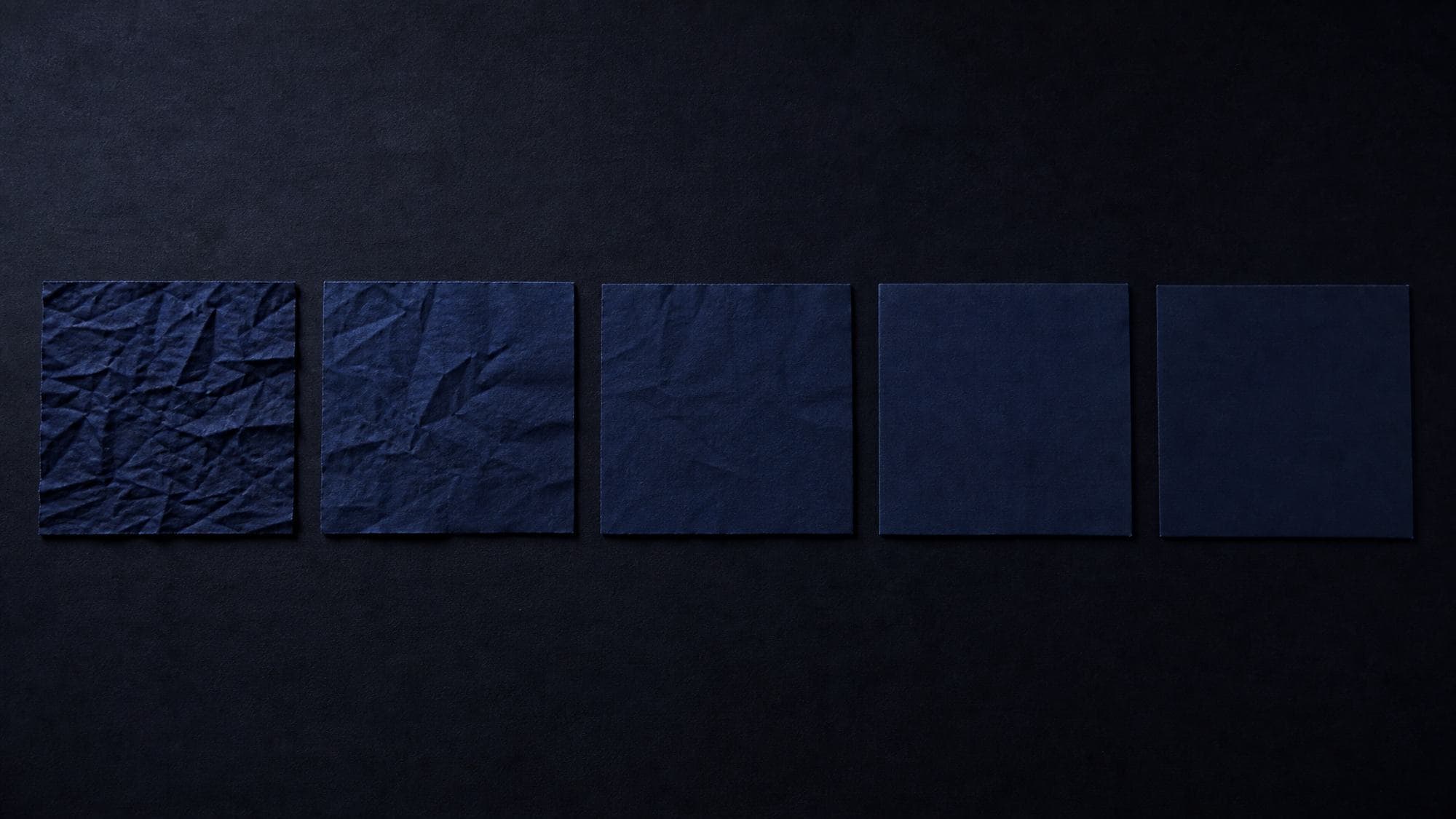
- 5No set creasingComes out of the bag with no visible fold line. Knits and crinkle-finish wovens sit here.
- 4Soft creasing at stress pointsLight creasing at the elbows, the rear yoke and behind the knee. Relaxes on a hanger in about 30 minutes. Most of our shirting sits here.
- 3Visible creasing across panelsFold lines readable across the body, not sharp. Around two hours on a hanger, faster in a steamy bathroom.
- 2Clear fold linesDistinct lines where the garment was folded. Needs a hang plus steam, or an iron, to look pressed. Our linen blend sits here.
- 1Sharp set creasesCreases that need an iron to remove. We do not currently sell anything at this grade.
What the grade does not tell you. It is read after a 30-minute hang, not straight out of the bag. It is measured on one fold pattern; a tighter roll or a heavier load will read worse. It is measured on a new garment, and the resin finishes that produce grades 4 and 5 on cotton-blend wovens lose effectiveness with washing — expect the grade to drop over roughly 40 home launderings.
Dry time
Published dry times are measured under one set of conditions, stated here in full:
- The garment is fully wetted, then spun in a domestic machine at 1,000 rpm for 4 minutes.
- It hangs unfolded on a plain plastic hanger, not touching another garment or a wall.
- Air is still. No fan, no open window, no heated rail.
- Ambient conditions are 22°C (72°F) and 55% relative humidity.
- Dry is defined as the garment returning to within 2% of its conditioned dry weight.
- The published figure is rounded up to the nearest half hour.
What changes it. A humid bathroom, a cold room, a folded garment, a garment laid on a towel, or one hung against a wall will all take longer — often twice as long. Hand wringing rather than spinning adds time as well. Treat the published figure as a best-realistic-case for a hanging garment in moving-enough air.
Packed volume, ±10%
Packed volume is the space a piece takes in a bag once compressed by one stated method. The method used for each piece is printed on its product page, and there are only three:
- Rolled — rolled from the hem by hand, firmly, no sack and no strap.
- Folded — folded in thirds and pressed flat under a 2 kg weight for 60 seconds.
- Stuffed — pushed into its own integrated sack or pocket and drawn closed to the stitched line.
The compressed piece is then measured by water displacement in a sealed bag, three times, and the median is published. Figures carry a ±10% tolerance. We do not describe anything as packing to a “minimum” size, because there is no standard behind such a statement.
Set totals — the capsules and The One-Bag Week — are the sum of the individually measured pieces. Each component carries its own ±10%, so a set total is a good planning figure and a poor precision one.
Water-repellent, not waterproof
Several pieces carry a durable water-repellent (DWR) finish. A DWR changes the surface tension of the outer face so water beads and rolls off instead of soaking in. It is a finish, not a barrier.
- What it does: sheds a spilled drink, light rain and wet grass for a limited period. On our Water-Repellent Shell that period is roughly 25 minutes of light rain before the face begins to wet out at the shoulders and wherever a strap presses.
- What it does not do: it does not keep out sustained or driven rain, and it does not stop water entering through zips, seams or openings. Nothing in this catalogue is waterproof, and none of it carries a hydrostatic head rating.
- It wears off: abrasion, dirt and detergent all degrade a DWR. Reproof every 15 to 20 washes with a wash-in or spray-on repellent, and tumble low for 20 minutes afterwards to set it. See fabric and care.
Sun protection
We do not print a UPF number on any garment. A UPF rating means something only when it comes from AATCC 183 testing on that specific fabric in that specific colour and weight, and we do not currently hold that testing for these fabrics. Rather than publish an unsupported number, we publish none. Any future UPF claim will name the test and the tested fabric.
Compression socks
Our compression socks state one figure: 15–20 mmHg at the ankle, graduated, decreasing up the calf, measured on a standard leg former. That is a garment specification.
It is not a medical claim and this is not a medical device. We make no statement about circulation, swelling, fatigue, travel-related clotting or any other health outcome, and nothing on this site should be read as one. If you have a medical reason to wear compression, that is a conversation with a clinician.
Claims we do not make
These are deliberate absences, not oversights:
- No antimicrobial, antibacterial or odour-control claims. Marketing a textile as killing or inhibiting bacteria, or as controlling odour by doing so, places it under United States federal pesticide law. We hold no such registration, so we make no such claim for any garment. Where a fabric is open and breathable we say that and nothing more.
- No claim that anything is immune to creasing. Every woven garment creases. We publish a grade instead.
- No waterproof claims. See above.
- No health, therapeutic or medical claims for any product, including the compression socks and the travel bra.
- No domestic-origin claims. Country of origin is stated per piece on its product page and matches the sewn-in label. We do not describe anything in this catalogue as domestically manufactured.
When figures change
Fabrics get re-sourced and finishes get reformulated. When a measured figure changes we re-test and update the product page, and we treat the piece as a new specification rather than quietly carrying the old number forward. If you bought something and the published figure has since changed, tell us — that is a valid reason for a return inside the return window even if the item has been worn.
Questions about this page
Email support@vagabondapparel.shop or call +1 614 108 9613. Monday to Friday, 9:00–17:00 Eastern Time.
VAGABOND APPAREL LLC · 11701 Lake Victoria Gardens Ave, Suite 5102, Palm Beach Gardens, FL 33410, United States